
NEET Counselling Process 2026: What Freeze, Float & Free Exit Actually Mean for Your Seat
The process changed this year — here's what to do differently
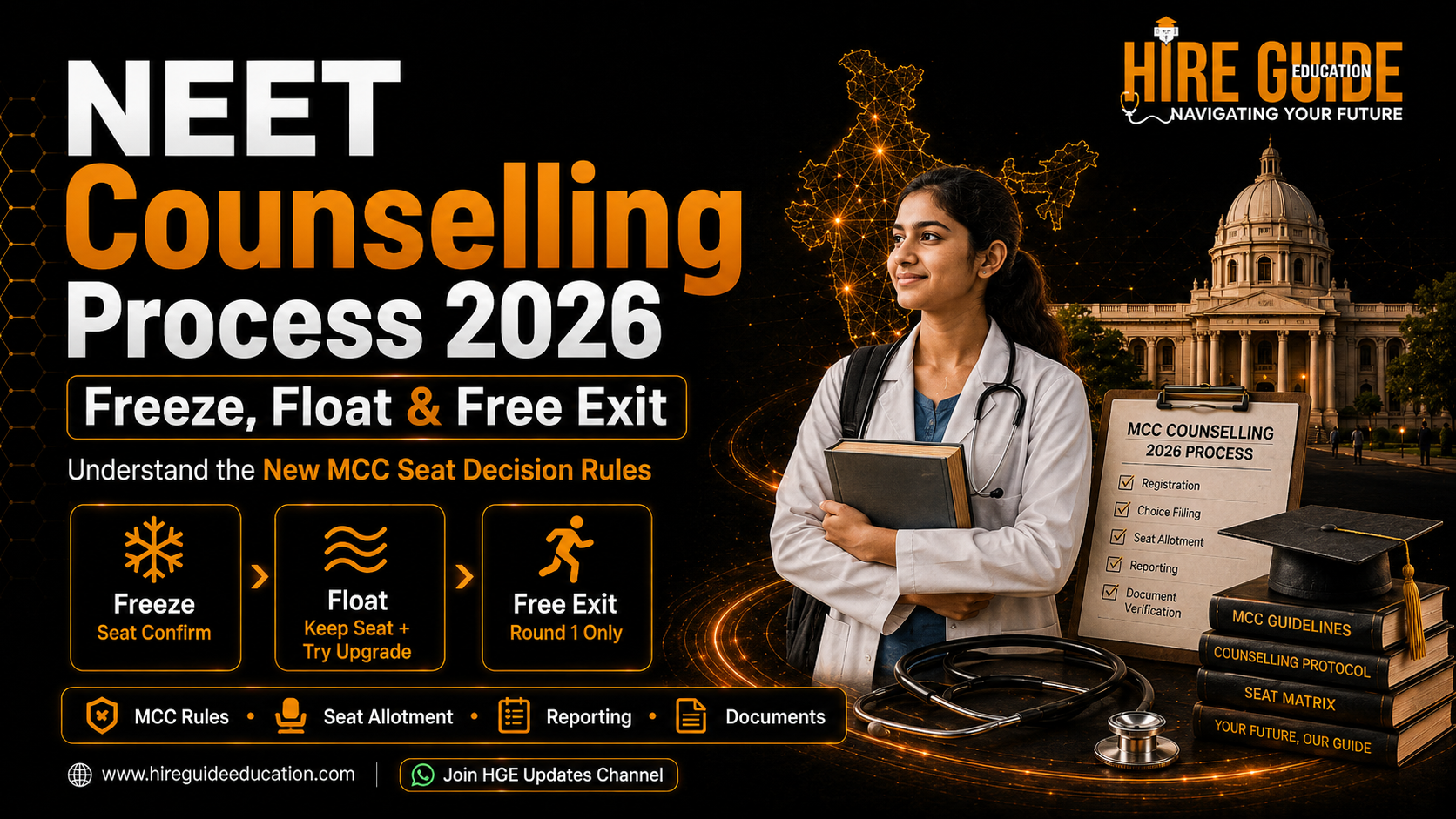
Quick summary
For years, the NEET counselling process followed a fairly predictable rhythm — get allotted, travel, report, hope for an upgrade next round. In 2026, MCC rewrote a big part of that rhythm. Two new terms — Freeze and Float — now decide whether you lock your seat immediately or keep quietly trying for something better.
Main explanation
Introduction
If you've been through NEET counselling before — or heard about it from an older sibling or senior — you probably have a mental picture of how it works: get your result, get allotted a seat, travel to the college, and physically sort out admission or hope for a better allotment next round. That mental picture is now only half accurate.
The NEET counselling process for 2026 still ends at the same destination — a confirmed MBBS or BDS seat — but the middle of the journey looks different. MCC has introduced a system that asks every allotted candidate a direct question after each round: do you want to lock this seat in, or keep it while you try for better? Your answer decides your entire next few weeks. Let's walk through exactly how.
How the NEET Counselling Process Used to Work
Earlier, the process of NEET counselling was fairly linear for most candidates seeking an upgrade — once you got an allotment, physically reporting to the college was generally the expected next step regardless of whether you planned to stay there or hoped for a better seat in the next round. This meant a lot of students travelling, submitting documents, and sometimes reporting to a college they didn't intend to join long-term, purely to keep their upgrade chances alive.
That's the exact friction MCC has tried to remove in 2026. The NEET UG counselling process now separates candidates into two clear paths right after allotment, based on what they actually want — finality or flexibility — instead of assuming everyone needs to travel and report in person to stay in the race.
Latest Official Update
Before registering for counselling, always verify the latest information from official authorities. Counselling schedules, seat matrix revisions, eligibility criteria, fees, and reporting instructions may change through official notifications.
Official Source | Use It For |
NEET application, exam notifications, admit card, result, scorecard, and All India Rank updates | |
15% All India Quota (AIQ), Deemed Universities, Central Universities, AIIMS, JIPMER counselling schedules and guidelines | |
Medical college recognition, approved seat intake, and regulatory updates | |
State quota counselling, domicile rules, reservation policies, seat matrix, and reporting instructions | |
College-specific tuition fees, hostel charges, bond conditions, and admission requirements |
Tip: Always refer to the latest official PDF or counselling portal before finalising your college preferences, as seat availability can change before each counselling round.
NEET New Rules for 2026: Freeze, Float & Free Exit
This is the single biggest structural change to counselling this year, so let's take each option one at a time — no jargon, just what it means for you practically.
What Is Freeze?
Freeze means you're satisfied with your allotted seat, you don't want an upgrade, and you're ready to finalise your admission. Choosing Freeze commits you to physically completing your admission at that college.
Freeze is the right call when:
You genuinely like the college and course you've been allotted.
The fee structure fits comfortably within your family's budget.
You're ready to travel and complete joining formalities without waiting.
Realistically, none of your remaining choices are meaningfully better than this one.
What Is Float?
Float means you want to hold onto your allotted seat provisionally while trying for something higher in the next round. You don't lose your current seat immediately — but you're also not walking away from the process, since you'll need to submit fresh choices for the upgrade attempt.
Float suits you when:
You'd genuinely prefer a different college or course but this seat is a reasonable fallback.
You're not ready to commit to physical joining just yet.
You understand that if you get upgraded, this seat is released automatically — and if you don't, you keep what you have.
What Is Round 1 Free Exit?
Free exit is specific to Round 1 — it lets you give up your allotted seat entirely, with your refundable security deposit protected. You don't retain the seat, you don't report anywhere, and you move into Round 2 with a clean slate to try fresh choices.
This is meaningfully different from Float: Float keeps your current seat as a safety net; Free Exit removes the safety net completely but costs you nothing financially in Round 1. That protection specifically does not extend the same way to later rounds — non-joining after Round 1 can lead to forfeiture of your deposit, so Free Exit is genuinely a Round 1-only privilege worth using wisely.
Freeze vs Float vs Free Exit — At a Glance
Point | Freeze | Float | Free Exit (Round 1 only) |
Upgrade wanted? | No | Yes | Not applicable |
Seat retained? | Yes, as final | Yes, provisionally | No |
Documents required | Mandatory, verified physically | Mandatory, verified online initially | Not applicable |
Physical reporting | Required immediately | Not required in early rounds | Not applicable |
Security deposit | Used toward admission | Protected while retained | Protected |
If upgraded next round | Not applicable | Earlier seat auto-released | Not applicable |
If not upgraded | Not applicable | Earlier seat stays retained | Not applicable |
The simplest way to remember it: Freeze finalises. Float protects while you try for better. Free Exit walks away clean — but only in Round 1.
So, Which One Should You Actually Choose?
This is where a counsellor's honest advice matters more than the rulebook. A few practical scenarios:
You'd happily study at this college even if nothing better came along? Freeze, and start your journey without waiting on a "what if."
This seat is decent, but you have a genuine, realistic shot at something better? Float — you lose nothing by keeping it as a safety net.
You're allotted something you truly don't want, in Round 1, and you have solid reason to expect better in Round 2? Free Exit protects your deposit while you try again — but only make this call with real cutoff data behind it, not just optimism.
The costliest mistake we see every year isn't choosing the "wrong" option — it's choosing based on incomplete information, like not checking whether your target upgrade is realistically within reach before giving up a working seat.
Start with These HireGuide Education Tools
Before you begin filling your choices, use these tools to research colleges and understand your admission possibilities.
Purpose | HireGuide Tool |
Research medical colleges | Medical College Directory – https://hireguideeducation.org/colleges |
Predict admission chances | NEET UG College Predictor – https://hireguideeducation.org/predictor |
Compare previous years' cutoffs | Cutoff Explorer – https://hireguideeducation.org/cutoff |
Understand counselling routes | State Quota vs All India Quota Guide – https://hireguideeducation.org/blog/state-quota-vs-all-india-quota-neet-ug-2026 |
Using these resources before counselling can help you create a balanced choice list based on your rank, category, budget, and admission goals.
NEET Counselling Process Step by Step (2026)
Here's how the actual journey looks now, from allotment to admission:
Seat allotted — your result shows your allotted college and course.
Choose your path — Freeze, Float, or (in Round 1) Free Exit.
Upload mandatory documents — required for both Freeze and Float candidates, on the MCC portal.
Verification begins — physical for Freeze candidates at the allotted college; initial online verification for Float candidates.
Resolve any document query, if raised — re-upload corrected documents promptly.
Complete your path:
Freeze candidates report physically, submit originals, pay the admission fee, and complete joining.
Float candidates receive provisional confirmation and submit fresh choices for the next round.
Next-round outcome (Float only) — if upgraded, your earlier seat is automatically released; if not, you retain what you already have.
Physical reporting isn't optional forever, though — even Float candidates should expect that final physical reporting becomes compulsory once their seat is finally settled in a later round, so don't assume you can stay entirely online through the whole process.
Mandatory Documents for NEET UG Counselling
Regardless of whether you Freeze or Float, document upload is non-negotiable, and MCC treats it largely as a one-time upload covering your counselling rounds. Our strongest practical advice here: don't wait until the deadline — upload within the first two or three days of your result, so you have time to fix any query without panic.
Your uploaded documents need to be:
Clear and fully readable, not cropped or blurred
Correctly oriented
Valid for the current admission year
Consistent with your NTA/MCC registration details
Properly supportive of your category or quota claim, where applicable
A document query usually gets raised for exactly the mistakes you'd expect — blurred scans, mismatched names, expired certificates, or an incomplete NRI or category record. If a query lands in your MCC login, treat it urgently: read it fully, arrange the correct document, re-upload immediately, and save your acknowledgement or screenshot as proof. Leaving a query unresolved within the reporting window can genuinely cost you the seat.
MCC Round 1 Result and Seat Allotment: What Happens Next
Once the MCC Round 1 result is out, the clock starts on your decision window — Freeze, Float, or Free Exit — and each path has its own next steps as covered above. This is also where most of the year's confusion happens, simply because students are making a financially and academically significant choice within a short, fixed window.
A quick reality check on MCC seat allotment logic worth remembering: your allotment is based purely on your rank, category, and the choices you submitted — not on last-minute negotiation or "adjustment" through any unofficial channel. If your Round 1 allotment feels unexpected, the fix is reviewing your own choice order and eligibility, not looking for a shortcut around the process.
Common Mistakes Students Make With Freeze and Float
Choosing Float purely out of hesitation, without a real target upgrade in mind.
Delaying document upload until the last day of the window.
Assuming Float means "no reporting ever" — physical reporting still applies eventually.
Not saving acknowledgements or screenshots after resolving a document query.
Using Round 1 Free Exit without checking whether Round 2 cutoffs realistically favour an upgrade.
Make Your Freeze-or-Float Decision With Real Data, Not Guesswork
Freeze, Float, and Free Exit are powerful options — but only if you're choosing based on realistic upgrade chances, not just hope. Run your NEET UG rank through the Hire Guide Education NEET UG College Predictor to see where you genuinely stand for the next round before you make the call.
Check your admission chances now — talk to a Hire Guide Education counsellor on WhatsApp before your Freeze/Float decision window closes.
Stay Connected with HireGuide Education
Need help throughout your counselling journey? HireGuide Education offers tools and resources to simplify every step of the admission process.
Medical College Directory
https://hireguideeducation.org/collegesNEET UG College Predictor
https://hireguideeducation.org/predictorCutoff Explorer
https://hireguideeducation.org/cutoffNEET UG Counselling Hub
https://hireguideeducation.org/counsellings/neet-ug
Disclaimer: This article reflects the MCC counselling process and rules as officially released at the time of writing. Always verify the latest procedure, deadlines, and document requirements directly on the official MCC portal before making your Freeze, Float, or exit decision.
FAQs
What are the new NEET guidelines for 2026 counselling?
The most significant change is the introduction of Freeze and Float as formal options after seat allotment, alongside a Round 1 Free Exit provision — designed to reduce unnecessary physical travel for candidates seeking an upgrade.
What's the latest MCC counselling update this year?
Beyond the counselling schedule itself, the standout update is this Freeze/Float restructuring of how candidates respond to their allotment — it changes the decision students make after every round, not just the dates.
Do Float candidates need to visit the college immediately?
Generally not during the initial rounds — Float candidates go through online document verification first. Final physical reporting becomes compulsory only once the seat is finally settled in a later round.
What happens if I don't resolve a document query in time?
Your allotted seat can be cancelled if a raised document query isn't resolved within the reporting period — treat any query as urgent, not routine.
Can I resign after Freezing and joining a college?
Where MCC permits resignation, it involves visiting the institute physically, submitting your request within the official window, and collecting proper acknowledgement — but once resigned, you have no further claim on that seat.
Is Round 1 Free Exit available in every round?
No — Free Exit with full security deposit protection is specific to Round 1. Non-joining in later rounds can lead to forfeiture of your deposit, so the same "walk away for free" safety net doesn't apply throughout.